
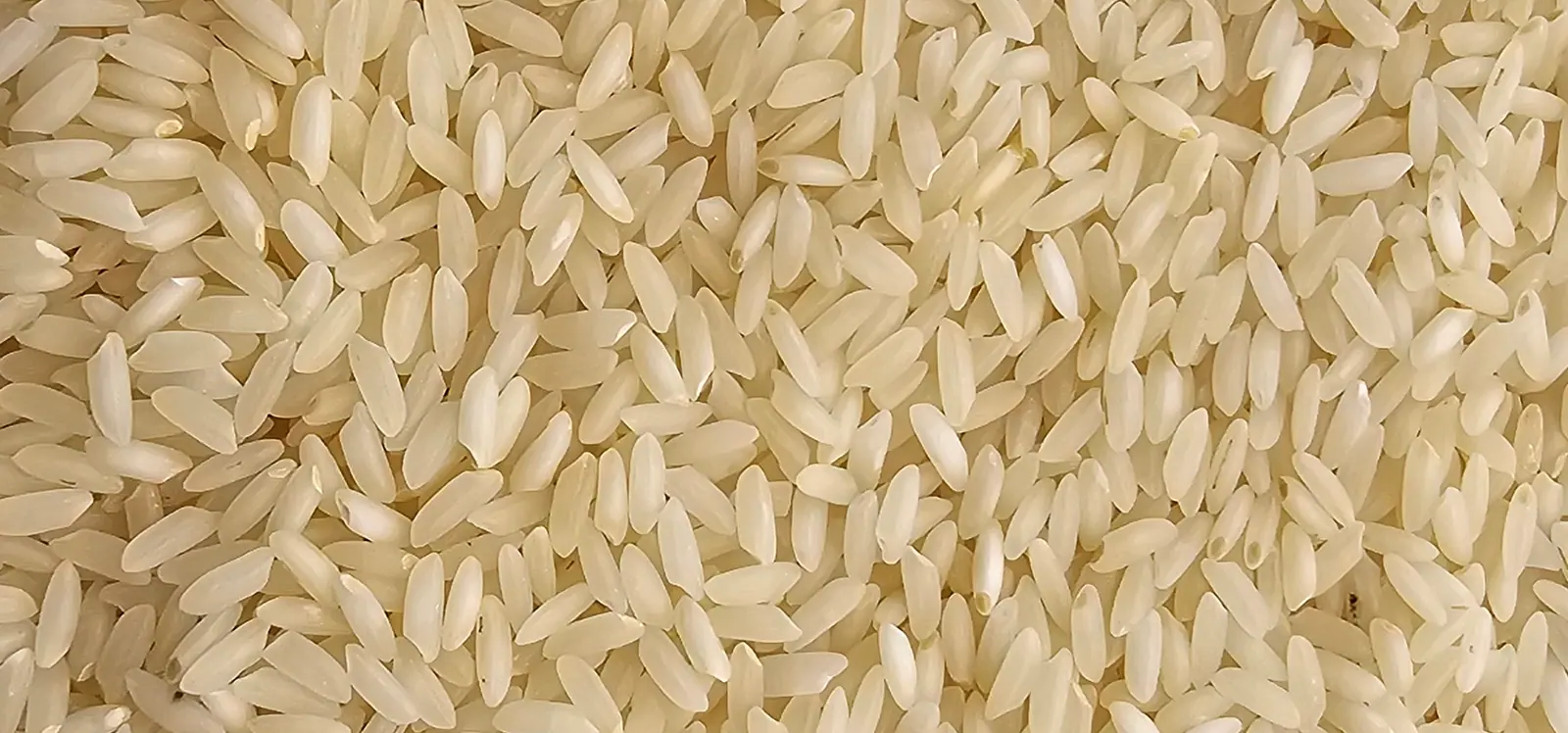
Buyers new to Indian rice often treat Sona Masoori and Basmati as interchangeable premium options. They are not. They are different grains, bought by different households, priced on different logic, and judged on different parameters.
The grain itself
Basmati is a long-grain aromatic rice. Its defining commercial characteristic is elongation: the grain extends substantially on cooking, staying slender and separate. Aroma is intrinsic, and ageing intensifies it. Grain length before and after cooking is a contract parameter.
Sona Masoori is a medium-grain, lightweight rice from the Telangana, Andhra Pradesh and Karnataka belt. It is lower in starch than many medium grains, cooks light and non-sticky, and is the everyday premium rice of South Indian households rather than a special-occasion grain.
Put a handful of each side by side and the difference is immediate: Basmati is noticeably longer and more slender; Sona Masoori is shorter, plumper and more uniform.
What each is bought for
| Sona Masoori | Basmati | |
|---|---|---|
| Typical use | Daily cooking, South Indian cuisine, idli/dosa households | Biryani, pulao, special-occasion cooking |
| Cooked texture | Light, soft, separate | Long, slender, firm and separate |
| Aroma | Mild | Pronounced, intensifies with ageing |
| Buyer's key parameters | Broken %, moisture, ageing, polish | Grain length, elongation, ageing, broken % |
| Volume behaviour | Steady household repeat volume | Peaks around festivals and hospitality demand |
For most GCC retail programmes serving a South Indian customer base, Sona Masoori is the volume line and Basmati is the complement — not the other way around.
Why the pricing logic differs
Basmati pricing is driven heavily by grain length and ageing. A longer, better-aged lot commands a materially higher price, and the same "Basmati" label can span a wide price range depending on those two variables alone. That is why a Basmati contract must state length and ageing explicitly.
Sona Masoori pricing moves more with crop, milling quality and broken percentage than with grain geometry. Two Sona Masoori lots at the same price can differ mainly in cleaning and breakage — which the customer notices in the pot, not on the shelf.
Ageing: the parameter buyers underestimate
Freshly milled rice of either type holds more moisture and cooks stickier. Ageing dries the grain and firms it up, so aged rice cooks more separate and absorbs more water.
Households that buy Sona Masoori habitually can tell aged from fresh crop immediately. If your customers are that kind of buyer, ageing belongs in your specification.
Steam, raw and parboiled — a separate axis
Ageing and variety are not the only variables. Processing is its own axis, and it applies to both:
- Raw — milled without heat treatment. Softest texture, most fragile, highest breakage risk in transit.
- Steam — steam-treated before milling. Firmer grain, lower breakage, favoured by food service.
- Parboiled (sella) — soaked, steamed and dried in the husk. Highest head-rice yield, golden tint, most robust in long transit and warm storage.
A useful shorthand: pick the variety for the customer, and the process for the channel and the journey.
Choosing for your channel
- Retail grocery serving South Indian households — Sona Masoori as the anchor SKU, in 5, 10 and 18 kg bags.
- Retail serving a mixed South Asian customer base — both, with Basmati in smaller pack sizes at a higher price point.
- HORECA and catering — steam rice for consistency under commercial cooking; Basmati where biryani is on the menu.
- Long-haul or warm-storage programmes — parboiled, for head-rice yield and shelf stability.
What to ask your supplier
Whichever you buy, the questions are the same, and a supplier who cannot answer them precisely is quoting a name rather than a product:
- What is the crop year, and how long has it been aged?
- What broken percentage and moisture percentage are you contracting to?
- Is the lot sortex cleaned, and to what polish?
- Will you send a pre-shipment sample from the actual lot?
- What is inspected at loading, and what record do I get?
Send us the answers you need against your buying specification and we will quote to it — for either grain.